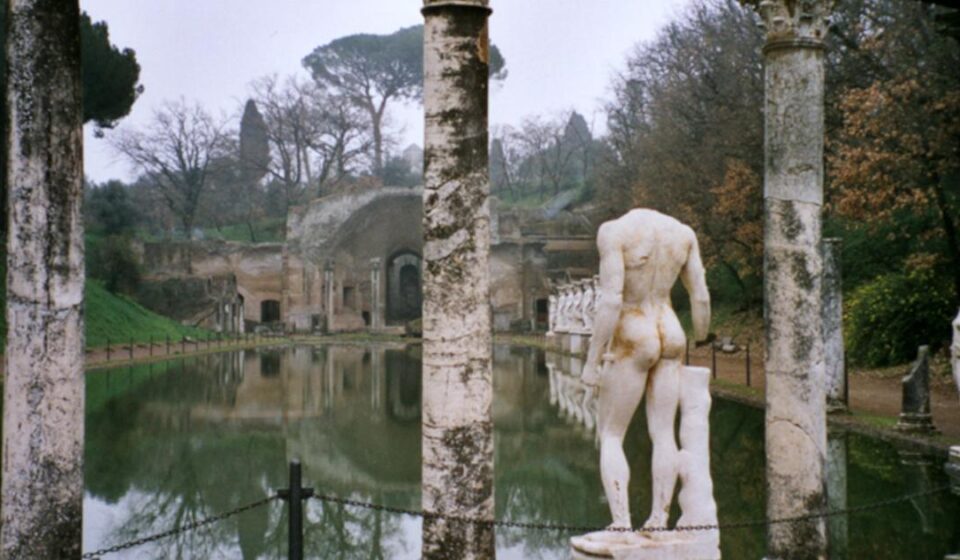

The extraordinary longevity of Roman concrete has puzzled scientists for centuries. Recent analysis of a 2nd-century AD latrine in Emperor Hadrian’s Villa is providing remarkable answers. Researchers have discovered that mineralized carbonates (specifically the slow, long-term formation of calcite crystals) are largely responsible for the incredible durability of these ancient structures. By examining the concrete matrix beneath a communal toilet at the luxurious Canopus western substructures in Tivoli, Italy, a team of international scientists has uncovered a self-healing mechanism that allowed the material to survive for nearly two millennia.
The study, recently published in Science Advances, used advanced multiscale imaging (including synchrotron-based micro-computed tomography) to observe the concrete at the nanoscale. While experts previously attributed Roman concrete’s strength primarily to the pozzolanic reaction between volcanic ash and lime, this new research highlights the vital, ongoing role of carbonation. Over centuries, residual lime reacted with atmospheric carbon dioxide and moisture to form an interconnected network of calcite crystals, effectively sealing cracks and reinforcing the structural integrity of the ancient material.
A Closer Look at the Latrine’s Volcanic Aggregate
The researchers focused their attention on a sample extracted from the concrete collector underneath the toilet seat of a latrine connected to the villa’s sewage system. This specific location provided an ideal, well-preserved sample of inland Roman concrete, allowing scientists to trace its mineralogical evolution. Through backscattered scanning electron microscopy and X-ray diffraction, the team identified the primary aggregate as a black volcanic lava composed of leucite, analcime, and ferrian diopside.
When Roman engineers mixed this volcanic rock with lime and water, it initiated the well-known pozzolanic reaction, creating calcium-aluminum-silicate-hydrate (C-A-S-H) binding gels. However, the study revealed that this gel only accounted for a small portion of the overall binding system. Instead, the volumetrically dominant binding phase proved to be calcite. The unhydrated calcium oxide within the mix gradually transformed into these stable carbonate minerals, filling pore spaces and voids over thousands of years.
The Self-Healing Power of Radiaxial Fibrous Calcite
The true magic of the latrine’s concrete lies in its ability to adapt and strengthen over time. As the carbonation process unfolded, a specific fan-like crystal formation known as radiaxial fibrous calcite grew outward from the reaction rims of the volcanic aggregates. This progressive mineralization created continuous mineral bridges across microcracks, improving load transfer and significantly reducing the concrete’s permeability to water and other aggressive chemicals.
“While the pozzolanic reaction is of fundamental importance, our findings suggest that carbonation over a long period of time also enhances the durability of concrete and can help it seal cracks as it ages,” explained Paulo Monteiro, Professor of civil and environmental engineering at UC Berkeley, in a statement. This slow, natural healing process explains why structures like the Pantheon and the Colosseum remain standing today, defying centuries of environmental stress and seismic activity.
Inspiring Sustainable Modern Construction
The discoveries made beneath the Canopus latrine at Hadrian’s Villa extend far beyond archaeological curiosity; they offer vital inspiration for the future of sustainable construction. Modern cement production, particularly the manufacturing of clinker, is notoriously carbon-intensive, contributing significantly to global greenhouse gas emissions. By understanding how ancient builders utilized natural carbonation and volcanic ash to create self-healing, long-lasting structures, modern material scientists hope to develop low-carbon alternatives.
While the researchers caution that the millennial timeline of Roman concrete’s carbonation cannot provide immediate climate benefits for modern infrastructure, the mechanisms observed offer conceptual guidance. The strategic incorporation of calcite crystallization dynamics could eventually lead to the development of resilient, low-clinker cementitious systems, proving that the engineering secrets of Emperor Hadrian’s era still hold immense value in the 21st century.